Blogs

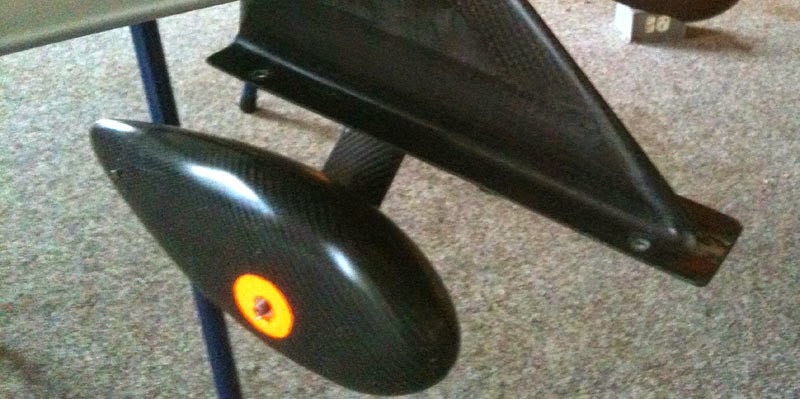
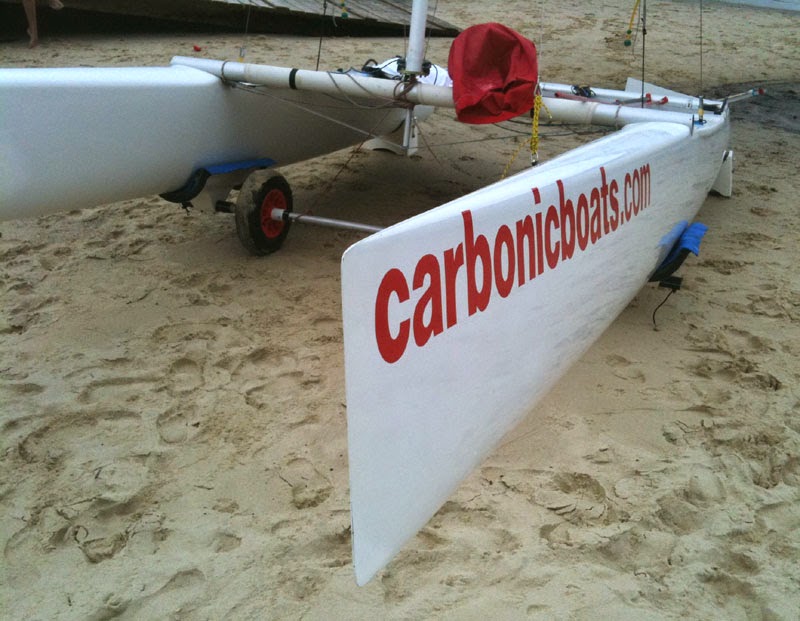
Just took delivery of this Boyer MkIV. Though not at the cutting edge, this boat represents a known platform, and a practical test bed for our development ideas.
The plan is to gradually modify the boat, replacing discrete components with our prototype parts.
Once we are happy with the detailing, we can transfer the successful ideas and components onto our newer second platform and eventually onto our prototype.
This is part of a broader programme to gather data (qualitative and quantitative) on the class as a starting point for the Carbonicboats A Cat project.
Those of you familiar with the Victorian scene might recognise the boat as the aptly named Obsession.
As our followers already know, at Carbonicboats our mission is to make the experience of the user of our products as pleasurable as possible. We believe in responding to the needs of the user with well designed, well thought out solutions, arrived at via careful research and development.
If you want your sailing to be fun, fast, ergonomically right, and good value, you can rely on our approach in the knowledge that we have done our homework.
The lower panel of the mast tube is 14mm outside diametre high modulus tube.
A piece of 16mm tube forms the basis of the horizontal element of the joint.
It is glued in place together with pieces of 14mm sleeve that form the first telescopic taper element of the main boom and jib yard.
The intersection, where the mast passes through the joiner, is reinforced by simply wrapping carbon ‘tow’ around it as a way to prevent the tube fibres from splitting, and to provide a tensile link between the tube skins.
Five minute epoxy is used to hold the parts together as tow is laminated on.
The boom and yard are 12mm tube and they need not be glued into the 16mm and 14mm joint body.
This solution also requires no fittings and is arguably simpler to create than a joint with box section or foam sandwich booms.

This is one solution for M class booms.
A bit labour intensive but light and stiff.
The balsa core in the elbow could be replaced with foam though arguably using balsa offers toughness.
There is possibly a windage advantage in round booms, and our experience shows this to outweigh the downwind projected area and end-plate effect of flat-sided main booms. Using round tubes allows a family of rigging solutions not possible with foam sandwich or box shaped booms.
The geometry is dictated by the foot round, following the deck as far aft as possible, then kicking up to meet the mainsail clew.
The booms step down in diametre at the joint. The joint is reinforced with carbon sock slipped into position then wet out with epoxy resin.
Ray is making progress with the rigs for the Octave prototype.
The design uses a simple method for cantilevering the cranes from the upper mast tubes.
After drilling, fitting, and bonding, carbon tow is used to prevent splitting.
The mastheads are filled with low density filler mainly to keep water out.
This system eliminates all fittings from this area where weight is critical.In a similar manner, the mast/yard junction is done with some 16mm tube.
The 14mm mast tube passes through the 16mm horizontal joiner. Carbon tow binds the junction together.
Main yard and jib yard plug into the 16mm tube then step down to 12mm and 10mm.

Screen shots in preparation for tooling files.
Part of the tendering process for outsourced production tooling.
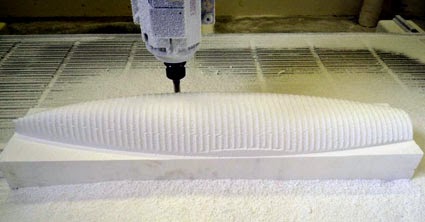
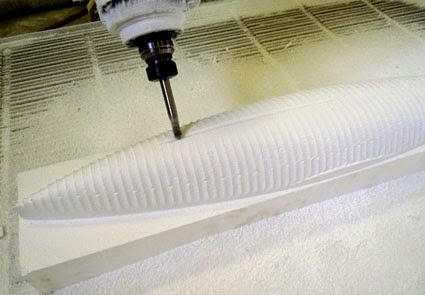
Chris Lawrence has had the first plug milled for BlackIce.
Moulds and a prototype will follow…
A view of design detailing for an open wheeler tub. The client was kind enough to allow us to share this view of the main carbon safety cell prior to fine detailing.
Very interesting to apply our knowledge and tools to different worlds.

While we are on cars… Here is a view of a prototype that we designed and aero optimised for Chauvel/Lolita a few years ago.
This project involved some pretty advanced airflow management with a diffuser/bumper/rear wing design that proved very effective.

A prototype airframe ready for flight testing.
We rarely get to post about this UAV project due to confidentiality concerns.
But this particular model is now out in the open, so here goes…

By way of background, it was commissioned by a local defence contractor working with Sinagapore Aerospace, BAE Systems, and Sydney University. We did the bulk of the modelling and structural optimisation.

This is one of three UAV projects currently underway, the other two being for a customers from Spain and Singapore. We are in discussions with the partners in the Spanish project to spin out a commercial version for the Australian market. This is a field that is rapidly growing, so watch this space.

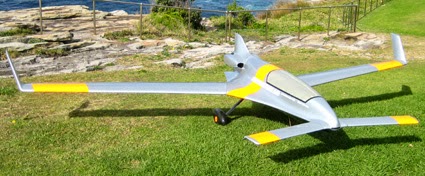
Some images cleared for release. Prototype Medium Altitude Long Endurance airframe construction details…

CAD drafting and optimisation work.
These images of a shortlisted (but not final) design have been cleared for release. Most aspects of the project remain classified.
Some images from a study commissioned by a Sydney owner for a harbour racer/day boat.
The concept is for a very clean, simple boat, easily handled by a small crew.
Cockpit size is prioritised over internal volume and accommodation.
A deep fixed keel can be retracted to reduce draught.
The hull form is of moderate beam to provide adequate form stability and cockpit space whilst maintaining balance when heeled.
Soft chines characterise the run aft but they are carefully placed in order to have minimum impact when sailing upwind.
Twin rudders are housed in ‘drums’ so that they can be partially or fully retracted as well as easily removed, serviced and repaired.
Consistent with the elegant, uncluttered character of the boat is the choice of rig configuration:
A cantilevered tube exits the deck and transitions to a wing profile.
Given the state of the art in composite spars, a semi-free-standing wing is an attractive solution with a favourable tradeoff between aerodynamic drag and weight.
Relatively small non-overlapping headsails are hoisted on integral fibre stays.
Provision is made for simple aft runners to optimise forestay tension and provide additional support when hard running.
The elimination of a permanent forestay greatly simplifies downwind sail handling.
The prototype boat has as an RC tray a simple horizontal shelf spanning the hull and capturing the fin trunk.
The mainsheet enters the boat through a fairlead immediately below the boom at the sheeting point.
A simple sheeting circuit goes to a block anchored inside the hull at the transom.
The turning block is offset in order to clear the rudder tube.
Ray has been measuring out and installing the sheeting system.
The hull/deck joiner serves to reinforce the anchor point for the turning block loop.
All in-keeping with the philosophy of the design: keep the deck clean and minimise the fittings/components…

Hello and welcome to the Carbonicboats blog.

We are ‘getting with the times’ and hope to post developments and news here on a regular basis.
Feedback is welcome, as always.

It is an exciting time with the America’s Cup entering a new cycle and several cool projects underway during the Australian winter.

We are selecting builders for production of Octave, our International M class RC yacht.

The prototype Octave is being rigged by Ray Joyce in Tasmania. All pictures featured of this boat are provided by Ray.

The IOM Black Ice is also being readied for production.

We have a 45′ yacht concept underway for a customer, and work continues on our A Division Catamaran development.

UAV prototypes are undergoing flight testing.  We are already looking at some radical concepts for launch and retrieval (having identified VTOL as a key requirement for wider adoption).

Carbonicboats exists with a mission to bring elegant engineering and advanced composites to premium markets. We’ve already diversified into aerospace applications as well as taking on some automotive and architectural projects.

To reflect this diversification we recently updated our branding to Carbonix.  This will be rolled out as we develop new collateral, starting with the new website.

Here’s to another iteration of our website. May it serve to inform and inspire.